What is accreditation?
Accreditation is an endorsement of a conformity assessment body's competence, credibility, independence and integrity in carrying out its conformity assessment activities.
Accreditation is an endorsement of a conformity assessment body’s (CAB’s) competence, credibility, independence and integrity in carrying out its conformity assessment activities.
Accreditation and certification are not the same thing
In everyday language the terms accreditation and certification are often used interchangeably. In the conformity assessment industry, however, these terms have very different and specific meanings.
ISO’s formal definition of accreditation is “third party attestation related to a conformity assessment body conveying formal demonstration of its competence to carry out specific conformity assessment tasks.” Certification is “third party attestation related to products, processes, systems or persons.” (ISO/IEC 17000)
TQC only accredits organisations that provide certification and/or inspection services. These organisations are known as conformity assessment bodies, or CABs.
| Certification | Accreditation | |
|---|---|---|
| Attests to | A product, process, system or person | The body that carries out that attestation |
| Carried out by | A certification body | An accreditation body |
| Answers | Does this system meet ISO 9001? | Is this body competent to decide that? |
What accredited CABs do
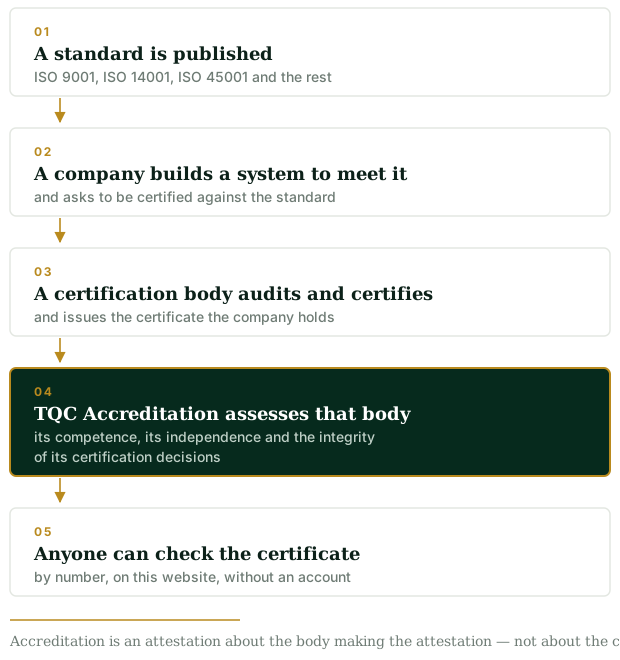
Accredited CABs provide certification and inspection services to organisations. Common schemes that CABs certify are quality management systems (QMS) based on the ISO 9001 standard, and environmental management systems (EMS) based on the ISO 14001 standard.
- ISO 9001:2015 — Quality management systems
- ISO 14001:2015 — Environmental management systems
- ISO 45001:2018 — Occupational health & safety management systems
- ISO 22000:2018 — Food safety management systems
- ISO/IEC 27001:2022 — Information security management systems
- ISO 13485:2016 — Medical devices — quality management systems
- ISO 50001:2018 — Energy management systems
Have a question about accreditation?
Tell us what your organisation does and we will tell you which route applies. Contact us